
Dictations: Old Tricks Revisited
Types of Dictations for EFL Classrooms
I started a ‘train the trainer’ course in January. At today’s session, we looked into some listening activities and dictation techniques.
As a teacher, I have never liked doing dictation in my class. It’s something I neglected. The only one I use is the wall dictation AKA the running dictation for motivating quotes whenever I feel my classes need motivational quotes.
For me dictation is a very boring activity or it used to be boring and useless. I mean just to check spelling, I can try something else and this feeling is because of my primary school teacher. She used to give us texts to memorise at home and in class sometimes she read them and we dictated or sometimes we wrote the text by heart.That was the biggest challenge. Whenever I hear the word dictation, I remember a scene me as a kid trying to write texts many times just as to learn how to spell the words.
However, today I realised there are really cool dictation techniques and some of them are as old as hills, yet very effective and fun.
I’ll try to list the ones I like now incase I forget how wonderful they really are.
1. Mixed ability dictations
Teacher divides the class into 3 according to students’ abilities. The lower level students get a text with multiple options for certain words or phrases, middle level students get a text with gaps and higher level ones get a blank page to fill when the teacher reads.
2. Running or wall dictation
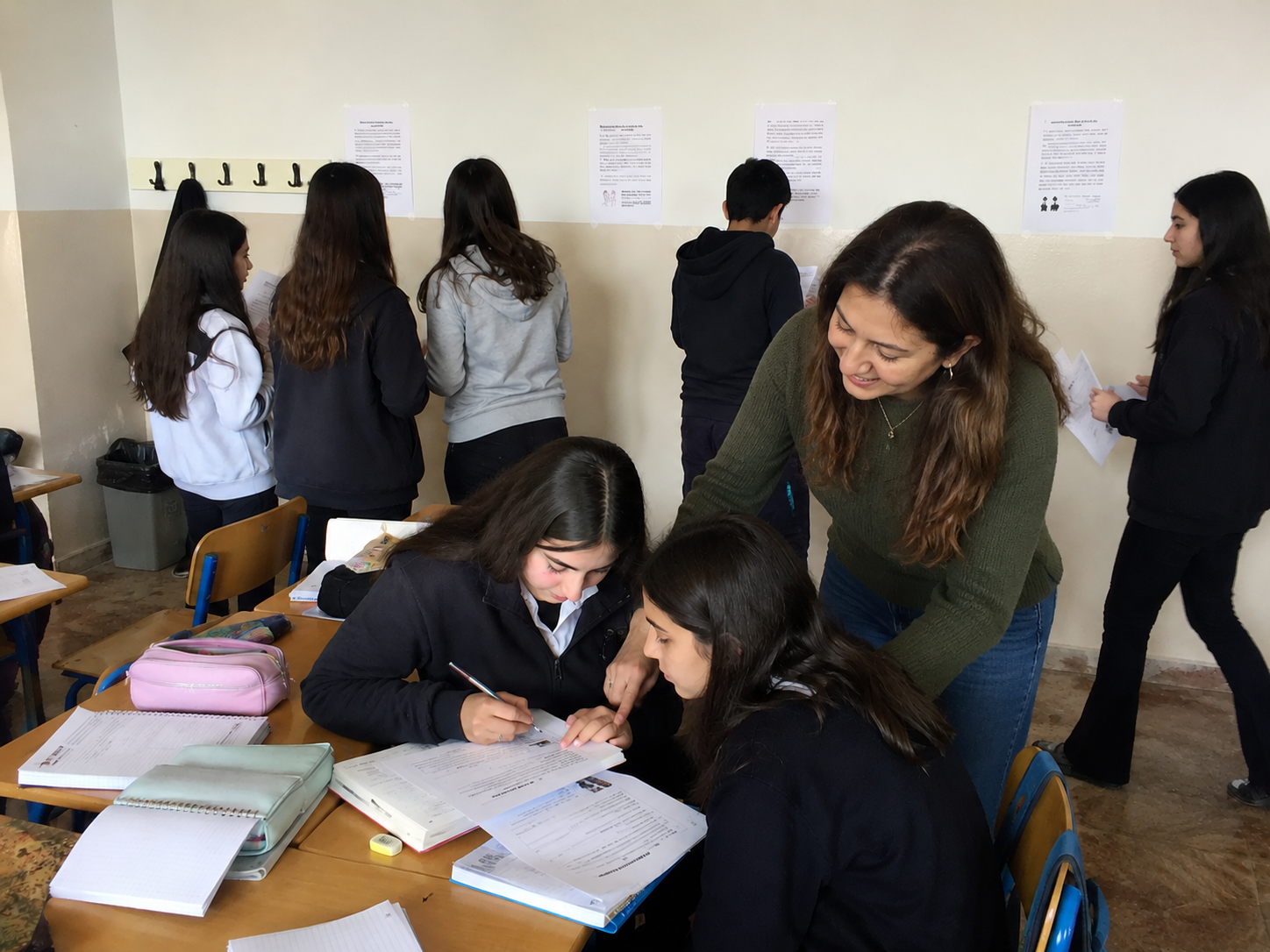
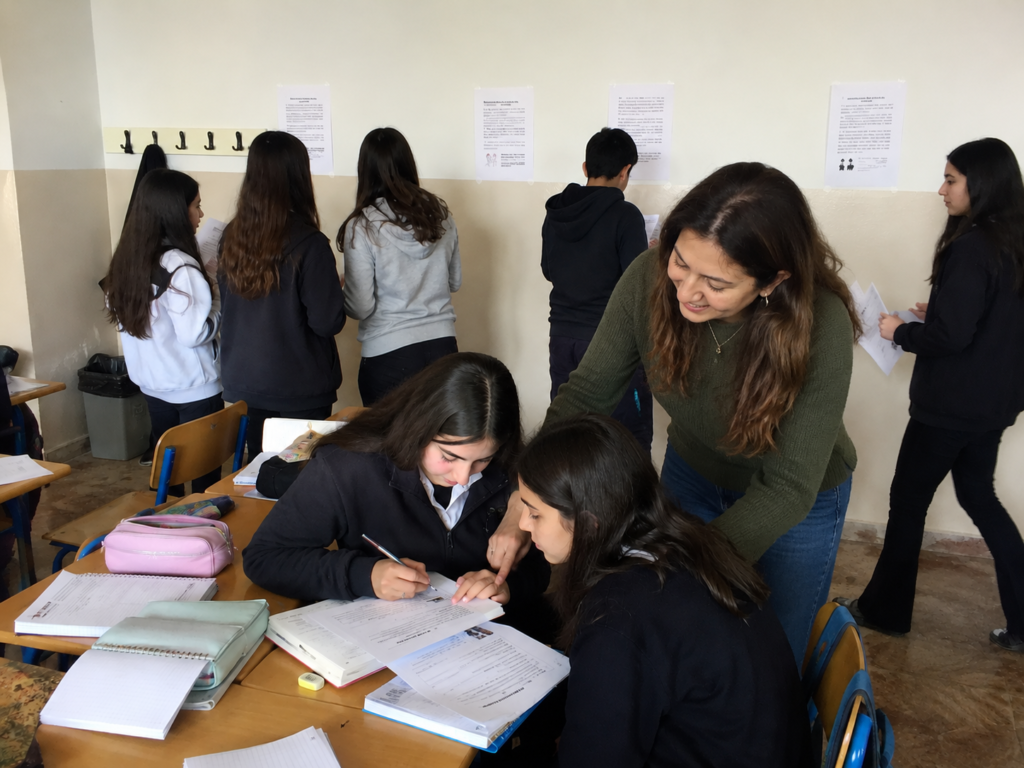
Teacher posts some texts on the walls and divides her class into groups. A person from each group should go to the wall, try to memorise a part of the text and come to the desk to dictate to her friend. Everybody from the group should go to the wall in turns and come back with a piece of text to desk to be dictated. We did an alternative to this today which I liked very much and thought it can also be a very good pre-reading activity. Teacher posts the texts on the walls and gives handouts with questions to be answered. Students should go to the text read it and find the anwser and come to the desk and dictate it.
3. Half the story
Teacher starts reading a story and after a while stops and asks a question and wants the students to write their answers and then waits them to write then she continues dictating the story, pauses and asks an other question, students answer and the process continues until the story finishes. In the end, each student has a different story. The stories can be displayed on the walls or teacher can ask them to find which one is the best. I think this one is a great pre-writing activity for narratives. Before we ask the students to produce their own stories we can provide an example with variety of linking words and then may be we can talk about how it was paragraphed, which conjunctions or tenses were used.
4. Cheating dictation
This is so challenging. Teacher reads the story at a normal speed without any pause. Students shouldn’t ask any questions while the teacher reads. The teacher won’t stop and repeat any word. When the teacher finishes the story, students in groups try to fill in the missing parts that they couldn’t catch. Then the teacher reads slowly and students check their texts.
Recently I’ve read a great post at Teaching Village by Nick Jaworski. There are more examples on how you can use dictation in your lessons.
More dictation ideas from this blog:


Great ideas & variations! Thanks for sharing, and also for the link to Nick Jaworski’s article. Something else that I do with MFL classes is get them to retell the text in a different text type (depends on the original text) – eg, as a diary entry of one of the characters for a fictional piece, or a similar creative response to the text. Hadn’t thought of the cheating dictation – looking forward to giving it a go!
Thank you Danielle for the idea too. It’s great. I’ll try it. Now I think dictations can be used as time fillers, pre and post activities for 4 skills even they can be good warmers.
I’ll use them more often.
Eva
These are great, Eva! I’ll definitely give them a try.
One additional thing I’ve done is to use dictation to reinforce interrupting and clarifying skills.
I have a hard time convincing students that it really is okay to interrupt a speaker for clarification.
First we practice various ways to control the language coming at you (Pardon me? More slowly, please! Did you say __? How do you spell __? etc.). Then I dictate a few sentences. I explain that I will happily stop, repeat, speak more slowly, and even spell the words in each sentence–all students have to do is ask.
Then, I read through my sentences at natural speed. The first time through, usually no one stops me. They’re waiting for me to notice that they aren’t following, and expect me to adjust my rate and difficulty….as a teacher normally would.
I repeat the instructions, and make it clear that I’m going to continue at natural speed unless they ask me to do otherwise.
By the third sentence, students generally get the feel for timing interruptions, and asking for clarification. They don’t necessarily apply the strategies to other English activities, but this kind of dictation is a very simple way to review the skills as needed.
I like that it’s not threatening. It allows my students to work as a team to try and figure out what I’m saying, and the goal is for everyone to succeed.
And it always gets a lot of laughs 🙂
Thank you Barbara,
Your trick sounds fun. Now I have more ideas to use with my classes. This collaboration makes me more creative. 😉
Eva
Hi Eva,
I was in a similar situation to yours; I always found dictation to be a time-consuming exercise in frustration with very little purpose. I found new respect for the technique later, and I really like your ideas here. I’d just like to add two to the mix.
Include dictation as part of your regular pronunciation work, but not for vowels/consonants. Rather, use it when you’re teaching sound reductions across word boundaries. This helps students to think about where the written words end and begin as opposed to the more or less continuous stream of audio. Also great for contractions with lower level students (how many times do people not hear the ‘ll or the ‘m simply because they haven’t practiced listening for it?).
Take the wall dictation to the next level and have teams of three with two seated on opposite sides of the room and one runner. Players rotate positions every 2 minutes.
Glad you found the article useful. I think people often forget about stuff we learned a long time ago. That’s why workshops can be so useful.
I like some of the ideas you and others shared here as well. I always love adding to my repertoire :).
Hi Eva,
Nice article, interestingly enough, I also recently blogged about 10 dictation variations I’ve used in my classes so far this year:
http://robertjohnsonrogers.edublogs.org/2010/05/11/10-dictation-variations-that-ive-used-this-year/
John