

Fast Finishers in the EFL Classroom
Beyond the Jar and Into AI The Fast Finisher Problem

We all know that moment. The task is still on the board. Most of the class is working. And there, a student sits looking around, waiting or doodling or whispering to a neighbour and you think “I should be doing something more for them.”
This is the fast finisher problem.
And it has been part of every mixed ability classroom I have ever taught in. However, now years later, I know that before we jump to solutions, there is something worth thinking about. Not all fast finishers are the same. There is the student who processed the task quickly and is ready to go deeper. There is the student who rushed through, produced something incomplete, and decided they were done. And then there is the one who has not really finished at all, but has decided that looking finished is easier than continuing.
Three different students. Three different needs. One label. And recognising which one is sitting in front of you changes everything.
What Fast Finishers Actually Need
They do not need more of the same. Finishing an exercise and being handed another identical one is not the solution. It may even be a punishment for being quick. The message, even if we do not mean to send it, is clear: if you finish faster, you’ll get more.
They do not need something completely unrelated to the lesson either. What fast finishers actually need is to go one step further, not to kill time.
If the lesson is about the past simple, the fast finisher task should still be on the past simple. If the class is working on a reading text about climate change, the extension should be related to that same topic.
However, we need to be sure what type of fast finisher we have because sometimes what looks like a fast finisher is actually a student who needs a different kind of support altogether. Then the teacher should be there to encourage the student to complete the activity.
So before we prepare a collection of extra activities for early finishers, it is worth asking a simpler question:
What does this student actually need right now?
For years, the fast finisher solution lived in a jar or an envelope or a laminated card stuck to the wall. We prepared a collection of Pinterest inspired generic tasks in advance, waiting for that moment when a student looked up and said, “I’m done.”
Yes, it was the best solution we had but those tasks were general and they were not connected to this class, this level, or these particular topic. They were fillers that saved that exact moment if the student was willing to complete because deep down the student was also aware that these were there to keep him/her busy as they wouldn’t be collected, shared, recycled or commented.
Now we can do much better than this using the tools we have around us. Maybe one day AI will replace the teachers, I don’t know but I believe, we are not there yet. We still need to decide what our students need, what is appropriate, and what is worth their time and as they are here and will obviously stay, we can use them as our assistants.
Jars are fun, gives the feeling of randomness. We can still keep them on the shelves but AI can also do something which will help our students more.
It can help us create something that belongs to that specific day.
Think about this: You are teaching a B1 class of sixteen-year-olds. Today’s lesson is on reported speech. You know your students and you are sure that at least three of them will finish the tasks sooner than others so before class you can prepare something for them.
While preparing these tasks, the most important thing is the prompt and for the prompt the questions to ask ourselves as the right questions help us design better activities.For example:
- What level are they really at?
- What skill do I want to extend?
- What language should they practise?
- What kind of thinking am I asking for?
What Good Fast Finisher Tasks Look Like
Fast Finisher tasks should stay connected to the lesson without simply adding more of the same.
Let’s have a look at a few fast finisher tasks
Vocabulary
Take the target vocabulary from the lesson and
- Create a word map for one of the target words. Include synonyms, antonyms, collocations, an example sentence, and a personal connection.
Grammar
- Take a short paragraph written in one tense and rewrite it in another. Notice what changes and what stays the same.
Reading
- Summarise the text in exactly 30 words.
Writing
Take your own writing from today and
- Rewrite the same piece in a completely different register. If it was formal, make it informal. If it was serious, add humour.
Speaking Preparation
- Write a 60-second mini talk on today’s topic. Something you could actually deliver to the class.
All these tasks are wonderful and can be completed independently and they can then be shared, displayed, discussed, or returned to. That last point matters more than it might seem. When fast finishers know their work will be seen, read, or used, not just collected and forgotten, the task gains a real purpose and it becomes part of the learning.
The Prompt Template
As I said, when you know your class well, you can easily guess if you will have fast finishers on that day’s lesson and you can prepare the task in advance. If you have access to internet and mobile tools in class, then you can even prepare a task for the unpredictable fast-finisher of that day in the class.
The most important thing is the prompt template. All we need is a ready-made class-specific prompt tailored to our needs. Something you type once, adjust slightly each time.
Here is the one I suggest. I improved it with the help of AI. I simply wrote what I needed and it guided me with questions to add more to get what I want.
“You are helping an EFL teacher create a fast finisher task. The students are [CEFR level], [age group], [grade if relevant]. Today’s lesson focus is [topic or skill]. The target language is [vocabulary list or grammar structure]. Create one fast finisher task that extends the lesson without introducing new content. The task should take between 5 and 10 minutes, require no teacher input to complete, and encourage deeper thinking rather than more practice of the same type. Keep the instructions simple and student-facing.”
Now let’s see it in action.
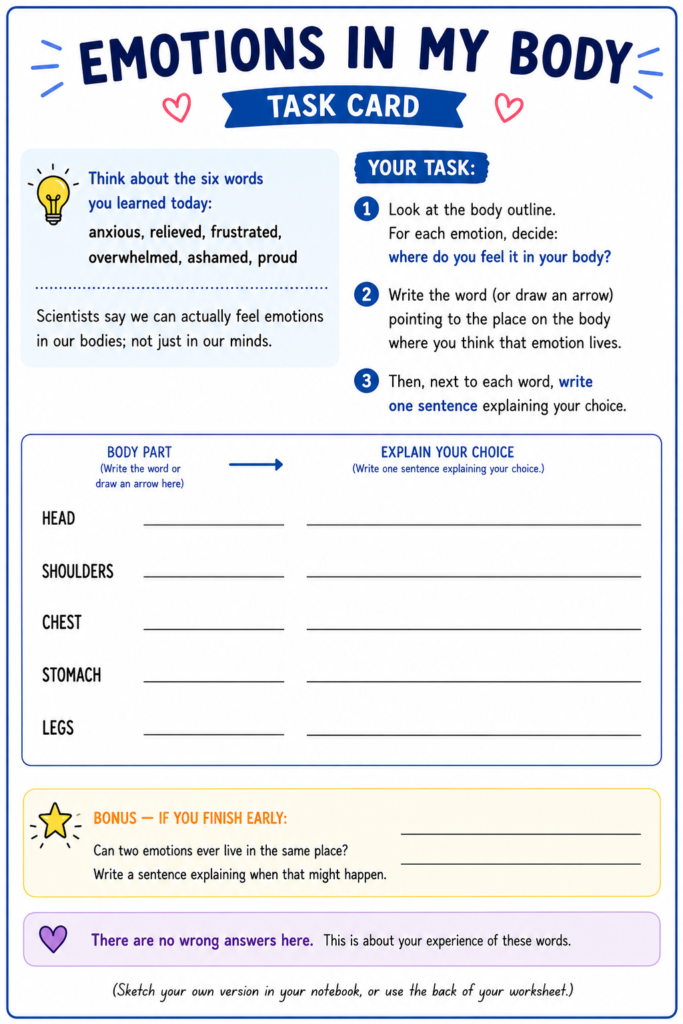
Example 1: Vocabulary lesson, secondary learners
You are helping an EFL teacher create a fast finisher task. The students are B1, teenage learners, grade 10. Today’s lesson focus is vocabulary. The target vocabulary is: anxious, relieved, frustrated, overwhelmed, ashamed, proud. Create one fast finisher task that extends the lesson without introducing new content. The task should take between 5 and 10 minutes, require no teacher input to complete, and encourage deeper thinking rather than more practice of the same type. Keep the instructions simple and student-facing.
AI output:
Example 2: Reading lesson, adult learners
You are helping an EFL teacher create a fast finisher task. The students are B2, adult learners. Today’s lesson focus is a reading text about the future of remote work. Create one fast finisher task that extends the lesson without introducing new content. The task should take between 5 and 10 minutes, require no teacher input to complete, and encourage deeper thinking rather than more practice of the same type. Keep the instructions simple and student-facing.
AI output:
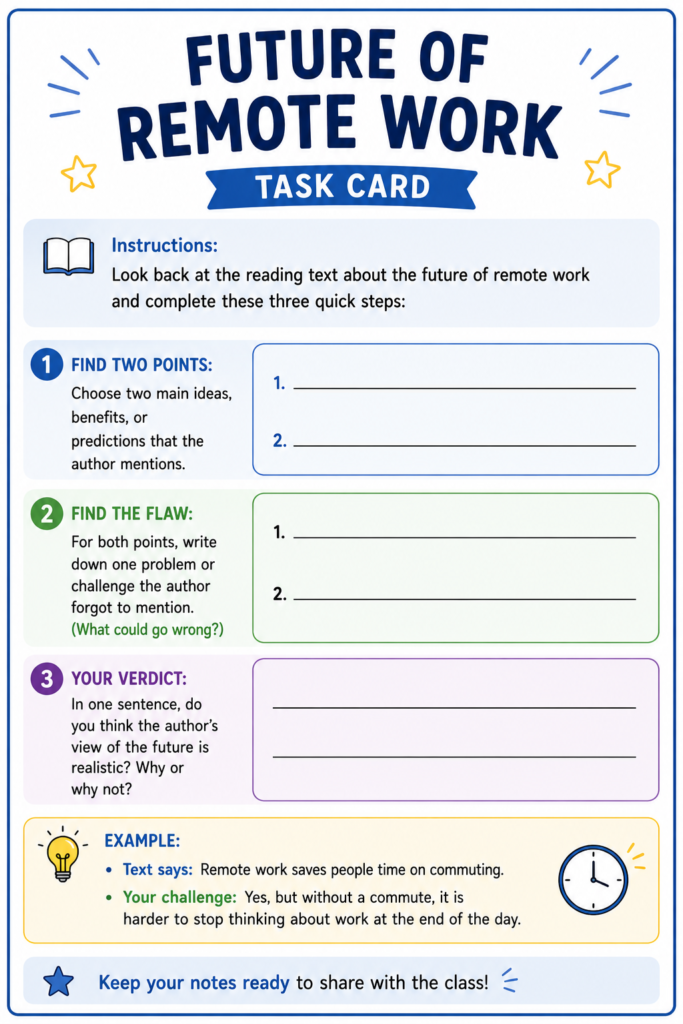
This template is a sample, but you can adjust it. You will notice that some additions make a difference. Over time, you will develop your own version. AI works best when the teacher guides the tool. It generates but you improve then it becomes yours. It is your pedagogy and your class. You know your students better. AI helps you find solutions. In this case, it simply does the job that the old fast finisher jar was trying to do, but faster and the best thing here is not the speed but the task which is connected to that day’s lesson.
What fast finisher strategies have worked in your classroom? Have you tried using AI to generate follow-up tasks? I would love to hear what is working for you.
Further Reading
- McWilliams, L. (2022, April 7). “Finished, teacher!” What to do with fast finishers in the young learner classroom [Webinar]. British Council Teaching English. https://www.teachingenglish.org.uk/news-and-events/webinars/webinars-teachers/what-do-fast-finishers-young-learner-classroom
- Oxford University Press ELT. (2024, March 7). Differentiation strategies for challenging advanced learners. Teaching English with Oxford. https://teachingenglishwithoxford.oup.com/2024/03/07/differentiation-strategies-challenging-advanced-learners/
- Fab English Ideas. (2014, April 8). Differentiation: What to do with fast finishers and slow starters. https://fabenglish-ideas.com/2014/04/08/differentiation-what-to-do-with-fast-finishers-and-slow-starters-my-harrogate-workshop/
💡 Want practical lesson plans, ready-to-use classroom materials, and AI tips delivered straight to your inbox every week? Join my free newsletter below:
