
How to End a Lesson Well: 21 Easy Closing Activities for EFL Teachers
Lesson Planning Essentials #5
This post is part of my series on effective lesson planning. Now I want to focus on how to end a lesson well.
When I observe teachers and give feedback on their lesson plans, I often say that a good lesson needs a good ending. Whenever we open a bracket, we need to close it. A lesson that starts with a warm-up but then ends suddenly feels unfinished.
Knowing how to end a lesson well matters, because the final minutes help make it stick. The final minutes of a lesson help make it stick. We should remember that a strong ending is as important as an effective warm-up. And when a lesson ends in a way students didn’t expect, it may create excitement for the next class.
So this post is about how to end a lesson well, with fun and creative ways to make it more memorable for your students. A closing activity helps both sides of the classroom.
For students, it:
- reviews the key points of the lesson
- recycles the language they have just learned
- helps them notice and understand what they’ve learned
- makes the lesson more memorable and interesting
For teachers, it:
- gives instant information about what has been learned and what needs more work
- shows common mistakes, so you can plan accordingly
- guides you in planning materials to reteach or recycle
- gives you a chance to evaluate the lesson and the lesson plan
And for both, it creates a smooth transition from one lesson to the next.
How to end a lesson well: closing activities we can use tomorrow
There’s no single answer to how to end a lesson well, so I’ve grouped these activities by type.
Write and reflect
3-2-1. This is a very versatile closing exercise for any age group and any level. It challenges students to remember what they have learned and notice what they have missed, and it gives them plenty to think about before the next lesson. It works for grammar, vocabulary, listening, speaking, reading and writing lessons. I’ve collected lots of 3-2-1 ideas in a separate post on my Substack.
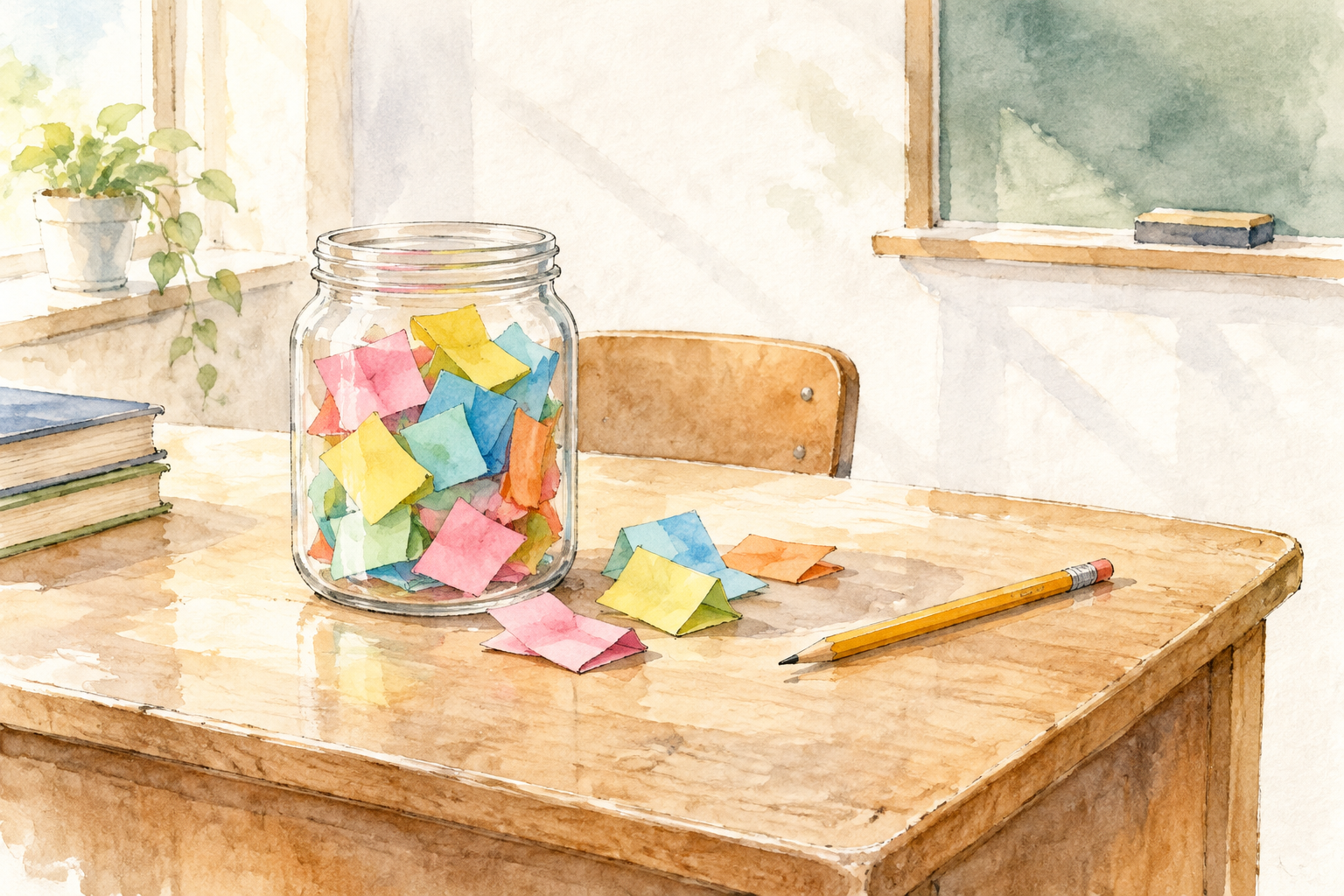
Choose a word. Students scan the vocabulary they have just studied, choose one word, and use it in a sentence. They write it on a sticky note or a slip of paper and drop it in a box before leaving the classroom. The next day, use their sentences to recycle the vocabulary as a correction exercise or a gap fill.
One-word response. Ask students for one word that describes something from the lesson. Then they have to explain or defend their choice.
Key ideas. Students list the key ideas from the lesson and say why each one was important.
Summarise the lesson. Students write how the lesson started, what they learned, how it ended, and what they understood well.
S-T-O-P summary. Students complete four sentences: We Started the lesson with…, The Topic was…, Our Opportunities to practise were…, The Purpose of the lesson was…
KWL charts. At the start of the lesson, students list what they Know and what they Want to learn. At the end, they complete the last column with what they Learned.
Learning journal. This can be a whole-term project if you find the right class for it. Students keep a journal and answer three questions after every lesson: What did I learn today? What can I use comfortably? What haven’t I learned well, and what do I need to study more? You can also ask students to reflect on their learning without guiding questions. If they learn to do that, it may be one of the most valuable skills they take into their future lives.
Make it visual
Mind mapping. Write a concept or phrase from the lesson on the board or on a chart. Students add related words and ideas around it.
Graphic organisers. Any graphic organiser can work, as long as it fits the lesson. Students fill it in with what they’ve learned, what they’ve missed, and how they will use it.
Social media post. Prepare a simple template that looks like an Instagram post. Students write a few sentences about the lesson with hashtags and pin their posts on the noticeboard.
Talk and move
Pass the ball. Students pass a ball to each other. Whoever catches it says something they learned that day: a word, a sentence with that word, or a question about the topic.
Inside-outside circle. Each student writes one question about the lesson topic. It can be a question they know the answer to, or one they want an answer for. Students form an inner and an outer circle, facing each other. They ask the person in front of them, swap roles, then rotate to a new partner.
Group report. This works at any stage of a lesson, and it’s especially useful at the end. Put students in groups to reflect on that day’s lesson. Then each group reports back to you.
Quizzes and games
Exit quiz. Use an online tool like Kahoot or Google Forms and ask students to answer a few questions about the lesson.
Jeopardy or noughts and crosses. If you have at least 10 minutes left, a quick review game works well as an exit ticket.
Something different: creative closers
If you’re looking for new ideas on how to end a lesson well, try one of these.
The six-word lesson. Students sum up the lesson in exactly six words. The limit makes them choose carefully. Read a few aloud or put them on the board for the next class.
Explain it to an alien. An alien has just landed in the classroom and missed the whole lesson. In pairs, students have one minute to explain today’s topic in the simplest words they can.
Gems and oops. From the beginning of the lesson through to the free practice stage, monitor the class and jot down sentences you hear: some good ones (gems) and some with mistakes (oops). At the end, write them on the board. Students decide which is which and fix the oops sentences together.
The error auction. Write six to eight sentences from the lesson on the board. Some are correct, some are not. Give each group an imaginary budget of 100. Groups bid on the sentences they believe are correct. The group that buys the most correct sentences wins.
Message in a bottle. Students write a tip for next year’s students about today’s topic: “When you learn the present perfect, remember…” It helps students reflect on their learning and also gives them practice in giving advice and making suggestions.
Plan the ending
A task takes longer than expected, and suddenly the bell rings. Even when the closing activity is in our lesson plan, we often skip those last minutes. We leave the class saying, “We’ll continue next lesson,” and the lesson is left unfinished. Everything in life needs closure, and so do our lessons.
And don’t forget to use the data you collected from these activities for your next lessons. A sentence on a sticky note, a question from the inside-outside circle, or an “oops” from the board can become tomorrow’s warm-up.
How do you usually close your lessons? Share your own tips on how to end a lesson well in the comments.
Further Reading List
Want more ideas on how to end a lesson well? These are worth a look.
- Three games to recycle vocabulary in the English language classroom (British Council, Voices Magazine)
- Supplementary activities for English language teaching: large classes and low resource contexts (British Council, PDF)
- 5 creative ways to close a lesson by Rebecca Sparling (The English Classroom)
- 22 powerful closure activities by Todd Finley (Edutopia)
- 6 wrap-up activities to close out lessons (ClickView)
💡 Want practical lesson plans, ready-to-use classroom materials, and AI tips delivered straight to your inbox every week? Join my free newsletter below:

