
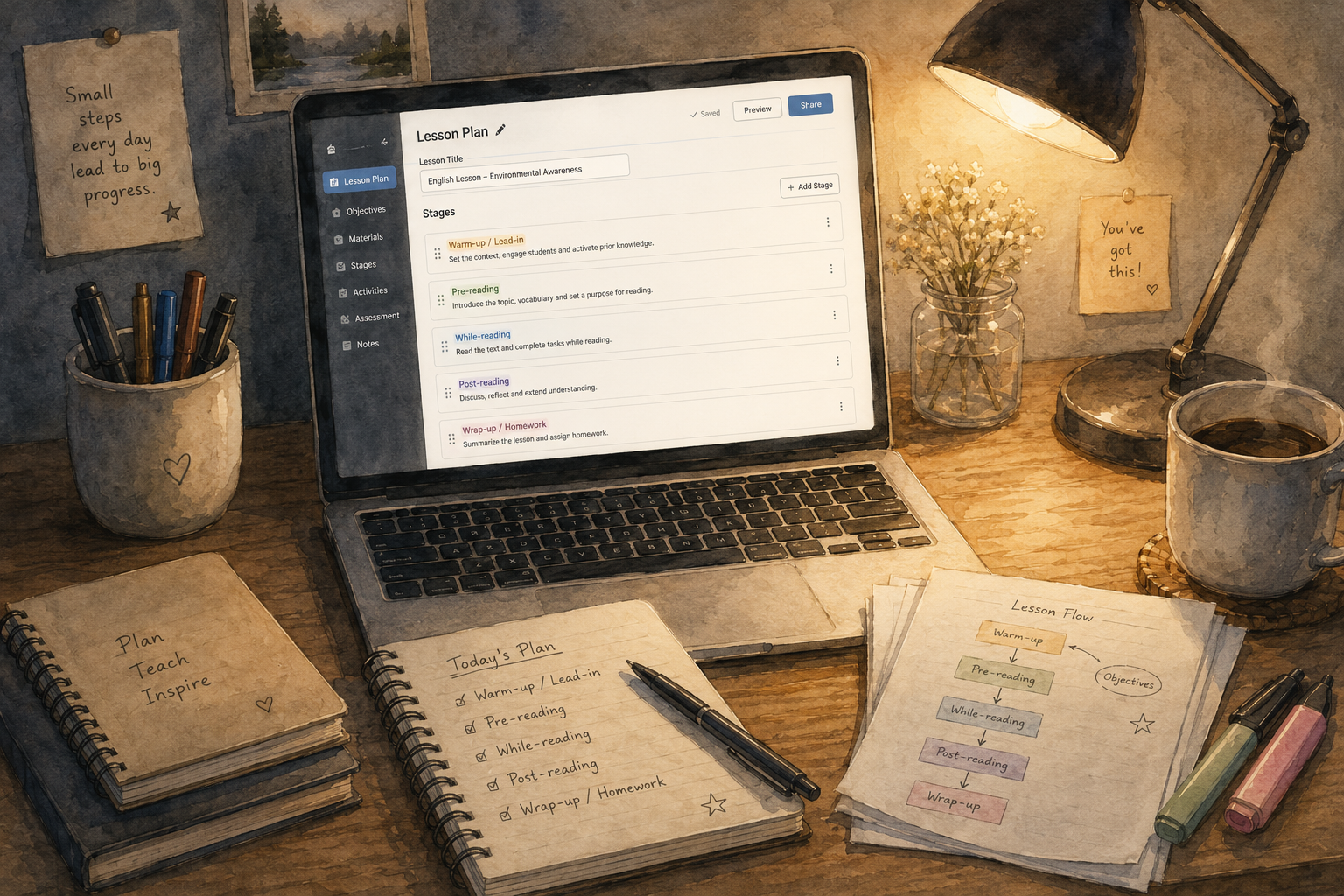
Lesson Planning Essentials #1: Warm-ups and Lead-ins
I’ve been planning to write something about lesson planning for a while, but I couldn’t decide how to do it. Then, while sitting on the couch and doing nothing for a while, suddenly I had this idea:
“I will think about a 45-minute lesson flow where there will be warm-ups, lead-ins, pre-, while-, and post-activities if it is a reading or listening lesson, and if it is a grammar lesson, then there will be noticing parts and practice stages, and then the wrap-up, and I’ll write a short post on each phase.”
Yes, voilà — that was the plan. So I’m starting from the very beginning: warm-ups and lead-ins.
In an ideal lesson, maybe the teacher should spend around 5 minutes warming the learners up and leading them into the tasks. Let’s imagine a 45-minute lesson. At the beginning, students often need to be woken up—mentally and emotionally—before any real learning can happen. This is where a warm-up fits. A brief, low-pressure activity at the very beginning helps learners switch into English mode and feel ready to participate. After a well-planned, relevant warm-up, what learners need is the context. This is where a lead-in appears on stage. A lead-in prepares students for the new language or skill by activating background knowledge and building interest in the topic.
However, in practice, these two stages are often confused. Teachers sometimes design warm-ups that attempt to elicit the target language too early. For example, if the target structure is be going to and the teacher tries to warm the learners up by asking, “What are you going to do in your summer holiday?” at the very start, the learners may feel blocked and intimidated, as they don’t have the necessary language to communicate.
A more effective alternative might be to begin with a light, engaging warm-up that focuses on familiar holiday vocabulary: a quick game about places to visit, types of holidays, or travel preferences. This kind of activity lowers the affective filter and helps learners to produce the new language. Then the lead-in can be used to guide students towards the target structure with clearer purpose and support.
Let’s summarize the nature of these two stages/activities:
Warm-up
What it is:
A warm-up is a short activity at the very beginning of the lesson to get students mentally, emotionally, and socially ready to use English.
Main purpose:
• Wake students up / Break the ice
• Switch them into “English mode”
• Lower anxiety
• Create energy and rapport
Key features:
• Not necessarily connected to the main lesson aim
• Low challenge, low pressure
• Often personal, fun, or chatty
• Short
Check these booklets:
https://www.linkedin.com/feed/update/urn:li:activity:7426939249532387329/
https://www.linkedin.com/feed/update/urn:li:activity:7426157925326569472/
Lead-in
What it is:
A lead-in is an activity that introduces the topic, context, or target language of the lesson.
Main purpose:
• Create interest in the lesson topic
• Activate background knowledge (schemata)
• Set up context for the main task or text
Key features:
• Directly connected to the lesson aim
• Helps students predict or notice
• Often leads naturally into reading/listening/speaking tasks
• Still short, but more focused than a warm-up
Lesson Planning: How Can You Tell the Difference?
Ask yourself this one question:
“If I remove this activity, does the lesson still make sense?”
- If yes → it’s probably a warm-up
- If no → it’s probably a lead-in
Can you have both?
Absolutely.
Example lesson flow:
- Warm-up: Quick chat about yesterday (3–5 mins)
- Lead-in: Pictures + questions about holidays (2–5 mins)
- Reading / listening / language focus
- Wrap-up
If you are looking for warm-up ideas to use right away, I have a few posts that might help. Feelings Translated is a quick and low-pressure starter that works well at any level. For more movement-based options, Mingle All the Way has plenty of ideas you can adapt. And if you want to see how warm-ups fit into a fuller lesson structure, the next post in this series will look at pre-reading and pre-listening activities.
💡 Want practical lesson plans, ready-to-use classroom materials, and AI tips delivered straight to your inbox every week? Join my free newsletter below:

3 Comments